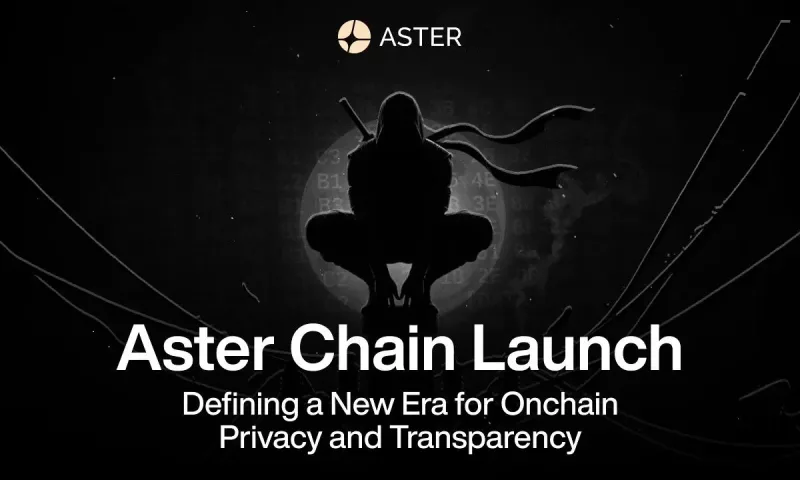
The Aster Chain mainnet launch went live on March 17, 2026, marking the move of Aster's perpetual futures trading ecosystem from relying on external chains like BNB Chain to running its own purpose-built Layer 1. Backed by YZi Labs, Aster positioned the launch around a single core idea: on-chain trading privacy should be the default state, not an optional add-on.
Why Aster Built Its Own Privacy-First Chain
Aster's team frames the launch as a response to what it calls DeFi's "transparency trap." Public ledgers are useful for verifying that a protocol is behaving honestly, but full transparency between competing traders is a different problem. When every order, position size, and liquidation level is visible on-chain, that information can be, and has been, used against traders directly. The team points to a widely reported March 2025 incident where a $375 million BTC 40x short position on a fully transparent platform was publicly hunted after traders coordinated on social media to pool funds against it.
How Privacy Works on the Aster Chain Mainnet
Account privacy is on by default across the network. Every order uses zero-knowledge proofs of encryption, and transactions route through one-time stealth addresses so that outside observers cannot monitor a trader's positions or behaviour. Rather than treating privacy as a third-party wrapper bolted onto an existing chain, Aster Chain embeds encryption directly into its execution layer, which the team argues removes the position-hunting attack surface entirely instead of just obscuring it.
Selective Disclosure Through the Viewer Pass
Full privacy by default does not mean zero transparency when it is needed. Aster Chain includes a feature called the Viewer Pass, which allows a trader to selectively decrypt and reveal specific activity to a chosen party, such as an auditor, a fund investor, or a regulator, without exposing that same data to the broader market. This creates a middle ground between full public exposure and complete opacity.
Performance Claims: Speed, Fees, and Throughput
Alongside privacy, the Aster Chain mainnet launch is built around zero gas fees for users, 50-millisecond block times, and throughput reported at up to 100,000 transactions per second. The network also runs a native bridge to BNB Chain and proprietary oracles intended to maintain high-fidelity price data for perpetuals markets, which is critical given how sensitive leveraged trading is to feed latency and accuracy.
Where Aster Stands Against Hyperliquid
Aster enters this phase as the second-largest perpetual futures decentralized exchange by trading volume, behind Hyperliquid. Reported daily volumes have fluctuated significantly through late 2025 and into 2026, with Aster posting 24-hour trades in the tens of billions of dollars on strong days, while Hyperliquid has periodically reclaimed dominant market share following its own product launches. Aster Chain is best understood as a structural bet that privacy-by-default becomes a genuine competitive differentiator as institutional capital enters on-chain derivatives trading, rather than a guaranteed path to overtaking the market leader.
Builders comparing infrastructure-level DeFi bets may also want to look at Hotstuff Labs' fiat-routing approach to its own Layer 1 launch, which targets a different problem within the same DeFi Layer 1 category.
Glossary
- Perpetual futures (perps): Derivative contracts that let traders speculate on an asset's price with leverage and no fixed expiry date.
- Zero-knowledge proof: A cryptographic technique that proves a statement is true without revealing the underlying data behind it.
- Stealth address: A one-time wallet address generated per transaction to prevent outside observers from linking activity back to a single identity.
- Viewer Pass: Aster Chain's feature allowing a trader to selectively reveal encrypted activity to a chosen party without exposing it publicly.
Disclaimer
Nothing in this article should be read as financial or investment advice; it is provided for informational purposes only. Perpetual futures trading carries substantial risk of loss, particularly with leverage. Confirm current network performance and token information directly through official launch coverage before trading.