The Casper Association published the Casper Manifest on May 12, 2026. It's a multi-year technical roadmap. The goal: make Casper Network the infrastructure layer for regulated real-world asset tokenization and the emerging machine-to-machine economy. Casper Association President and CTO Michael Steuer introduced the Manifest at the Digital Finance Forum in Bermuda, before an audience from Web3, traditional finance, and institutional finance.
What Casper Network Actually Is Today
Casper Network (CSPR) is a Layer 1 Proof-of-Stake blockchain built for regulated real-world assets and the machine economy. It features deterministic transaction finality, a multi-VM execution layer supporting WebAssembly and, soon, EVM smart contracts, and fixed-cost operations enforced at the protocol level. This roadmap builds directly on major releases since mid-2025, including Casper 2.0's deterministic finality and multi-VM execution layer.
The Nine Coordinated Initiatives, Organized Around One Goal
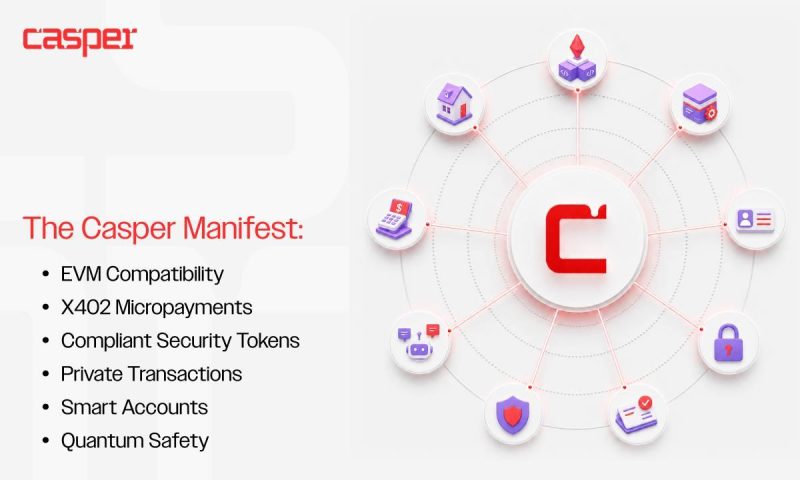
The Manifest sets out nine coordinated initiatives around one goal: make blockchain frictionless for users, trusted by institutions, and native for machines. The roadmap brings EVM compatibility to Casper's WebAssembly foundation. It advances gasless transactions and smart accounts for simpler user experiences. And it expands compliance, privacy, micropayment, native token, and quantum-safe infrastructure so real-world assets and autonomous systems can operate with less friction.
Why EVM Compatibility Specifically Matters for Developer Access
The largest blockchain developer ecosystem builds on Ethereum tooling: Solidity, MetaMask, and thousands of audited smart contract libraries. Casper is adding full Ethereum Virtual Machine compatibility alongside its existing WebAssembly execution engines. Developers can bring their existing contracts, tools, and wallets to Casper without modification. That removes a significant adoption barrier for developers already building on Ethereum.
What Gasless Transactions and Smart Accounts Actually Enable
The Manifest delivers gasless transactions, batch operations, and smart accounts with biometric authentication. Using a blockchain application should feel like using any other app. Users shouldn't need to understand gas fees, wallet seed phrases, or transaction signing mechanics upfront.
How Compliance and Privacy Work Together in This Roadmap
Casper is positioning itself as the first Layer 1 where regulatory compliance and transaction privacy work together, not against each other. The roadmap includes compliant security tokens with on-chain identity verification, transfer restrictions, and jurisdictional controls. These are built in alignment with the ERC-3643 standard, which already governs $28 billion in tokenized assets on-chain. Casper Association is a member of the ERC-3643 Association, helping expand that standard rather than building a competing, incompatible framework.
The Privacy Roadmap's Specific Design Goal
A multi-phase privacy roadmap delivers confidential transactions with fixed, predictable costs. It also includes built-in tools for auditors and regulators to verify compliance without exposing transaction details publicly. That combination, private transactions that stay independently auditable, addresses a tension that has historically made privacy-preserving blockchain infrastructure hard for regulated institutions to adopt.
Why This Roadmap Also Targets the "Machine Economy"
Beyond real-world asset tokenization, the Manifest's scope reaches AI agent micropayments and autonomous machine-to-machine commerce. It positions Casper's infrastructure for a future where autonomous software agents, not just human users, transact directly on-chain. Quantum-safe cryptography rounds out the nine initiatives, addressing a longer-horizon security concern relevant to any blockchain meant to stay viable across a multi-year deployment timeline.
Multi-year roadmaps targeting regulated institutional infrastructure like this reflect the same long-horizon compliance investment seen in Blockmaze's compliance-first RWA tokenisation platform, both betting that regulatory depth, not just technical capability, will determine which blockchain infrastructure institutions adopt.
The parallel is worth noting in Rayls Public Chain Delivers Sub-Second, EVM-Compatible Finality, which covers a related development from a different angle.
A related pattern shows up in Status Network Gasless L2 Uses Karma, Not Gas Fees, where a comparable dynamic plays out in a different corner of the market.
Glossary
- Deterministic finality: A blockchain property guaranteeing that once a transaction is confirmed, it cannot be reversed or reordered.
- ERC-3643: A token standard designed for compliant, permissioned security tokens with built-in identity verification and transfer restrictions.
- Multi-VM execution layer: A blockchain architecture supporting multiple different virtual machine environments, here WebAssembly and EVM, within a single network.
Disclaimer
This overview is for informational purposes only and is not financial or investment advice. Roadmap initiatives are subject to change during development. Confirm current details directly through official Casper Network announcements or the full Manifest at casper.network/news/manifest.