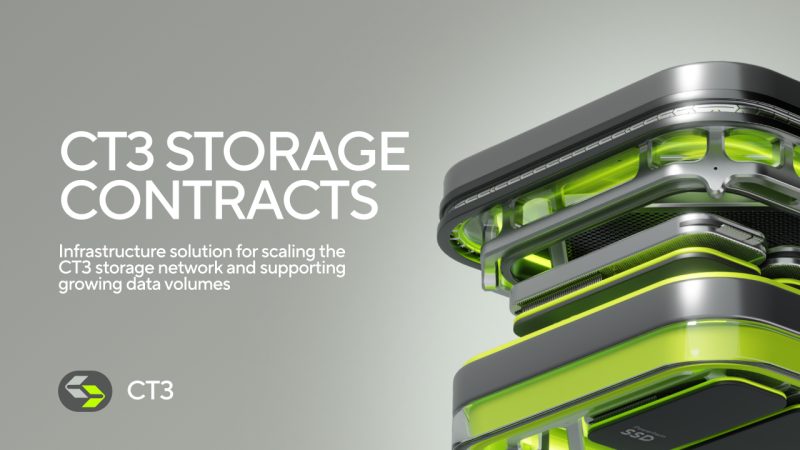
CT3 announced the transition of its decentralized storage infrastructure to a dedicated CT3 Storage Contracts model designed to support continued platform growth, improve infrastructure scalability, and expand storage capacity as demand increases. The transition follows rapid growth across the CT3 ecosystem, with more than 180,000 unique users having used the platform and more than 500,000 uploads completed to date.
How CT3's Underlying Infrastructure Actually Works
CT3 is developing a decentralized data storage infrastructure that combines independent nodes, the ct-3.cloud interface, NFT access keys, and blockchain verification. Users upload files through ct-3.cloud, after which the data is distributed across network nodes. An NFT key is created for every stored object, confirming access rights and containing the relevant storage metadata. That lets platform activity and network usage be independently verified on-chain.
Why the Previous Single-Contract Model Reached Its Limits
Previously, keys were issued primarily through the main collection and a single contract flow. Continued growth in demand for ct-3.cloud services increased pressure on that existing infrastructure. This created the underlying motivation for moving toward a more distributed architecture, rather than continuing to scale a single, centralized contract structure.
What Actually Changes Under the New Architecture
Under the new architecture, new uploads are distributed across dedicated Storage Contracts, rather than a single main contract. Each Storage Contract is linked to a fixed amount of storage capacity and operates as an independent infrastructure segment with its own capacity, utilization level, and on-chain statistics. That separation makes the infrastructure more resilient and lets individual areas of the platform scale without rebuilding the entire system.
How Financing and Profit-Sharing Actually Work
Participants may finance the deployment of new Storage Contracts and the addition of storage capacity. The allocated capacity is used to store files uploaded through ct-3.cloud, while the resulting profit is shared between CT3 and the participant who financed the infrastructure expansion. That directly ties infrastructure investment to a specific, independently verifiable revenue stream, rather than a purely speculative token allocation.
How Transparency Actually Works Under This Model
Through the smart contract address, an investor can verify issued NFTs, collection activity, and the actual use of the capacity they helped finance. The combined size of files associated with a given set of keys can be compared with the utilization figure displayed for the contract. That lets participants independently confirm that financed capacity is being used as described, rather than sitting idle.
Why Larger Contracts Serve a Distinct Purpose
Larger contracts can accommodate heavier files and more substantial flows of corporate or backup data, letting the network direct workloads to infrastructure segments with sufficient available capacity. That segmentation by contract size lets CT3 route different types of storage demand to appropriately sized infrastructure, rather than forcing all uploads through undifferentiated capacity.
What This Transition Means for Existing Users
For ct-3.cloud users, the experience remains unchanged. Both existing and new NFT keys continue to be supported, and the transition to the new architecture requires no additional action on the part of current platform users. That continuity distinguishes this as an infrastructure-layer change, rather than a user-facing product change requiring migration steps.
Distributing infrastructure workloads across independent, individually financeable segments like this reflects the same scalability approach seen in BASIS.pro's execution-layer infrastructure, both aimed at supporting growth without rebuilding core systems from scratch.
The same underlying theme surfaces in Logos Private Tech Stack Unites Codex, Nomos, Waku, illustrating how this pattern isn't isolated to a single project.
Glossary
- Storage Contract: An independent smart contract segment linked to a fixed amount of storage capacity, operating separately from other segments within CT3's network.
- NFT access key: A token confirming access rights to a specific stored file, containing relevant storage metadata verifiable on-chain.
- Infrastructure segment: A distinct, independently operating portion of a larger network, here each with its own capacity, utilization, and statistics.
Disclaimer
This piece is intended purely as informational content, not financial or investment advice. Financing storage infrastructure carries platform and market risk. Confirm current details directly through official CT3 announcements.