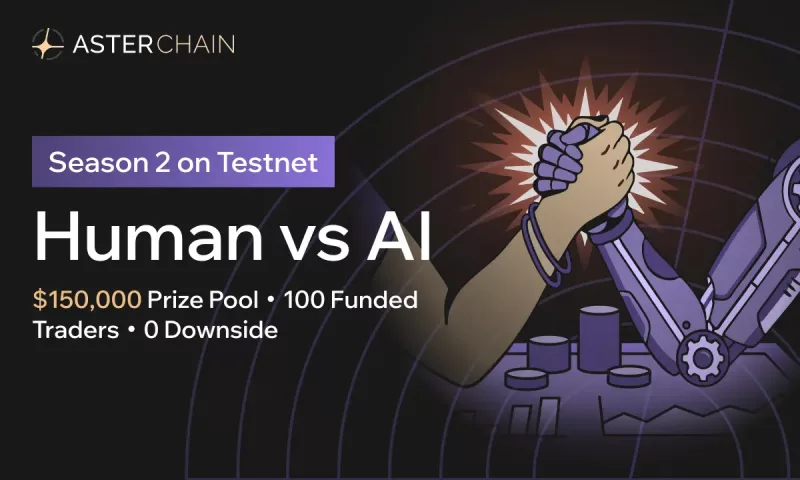
Aster's Human vs AI trading competition wrapped its first season in January 2026 after two weeks of live, real-money trading under volatile market conditions, and the aggregate numbers told a clear story: individual human skill produced the top result, but AI-driven strategies were far more consistent as a group.
How the Human vs AI Trading Competition Was Structured
The event ran for two weeks on Aster's on-chain perpetuals infrastructure, pitting a roster of human discretionary traders against 30 AI trading agents under identical, live market conditions rather than backtested or simulated data. Aster stated the goal was to observe how different types of participants behave on the same decentralized infrastructure under real volatility, not to declare humans or AI obsolete.
Individual Winner vs. Group Performance
Human trader ProMint took the top individual ranking with positive net profits, showing that skilled discretionary trading can still outperform systematic strategies at the individual level. But the human trading team as a whole posted a combined return on investment of -32.22%, reflecting wide performance dispersion: some traders posted individual gains exceeding $19,000, while others recorded losses approaching $18,000.
AI Agents Delivered Lower Volatility, Not Higher Returns
The 30 AI agents collectively limited total losses to roughly $13,000 and posted an aggregate ROI of -4.48%, a materially smaller drawdown than the human group despite operating in the same volatile conditions. Every single AI agent completed the competition without a single liquidation, achieving a 100% survival rate, compared with a 43% liquidation rate among human participants.
What the Results Actually Show
The gap between human and AI results is less about who "won" and more about risk control under pressure. Aster's own framing emphasizes that AI-driven strategies demonstrated structural strength in stable, risk-managed execution, where systematic rules prevent the kind of large, emotion-driven drawdowns that hit some human participants. At the same time, ProMint's individual result shows that strong human judgment and narrative awareness can still outperform in fast-moving, nonlinear conditions that are harder for rules-based systems to anticipate.
Aster's Stated Direction After Season 1
Rather than framing the event as humans versus machines with a winner and a loser, Aster CEO Leonard described it as "a starting point," arguing that future competitiveness in on-chain trading will come from collaboration between human judgment and AI-driven risk management rather than direct confrontation between the two.
This event followed shortly after Aster introduced Shield Mode, a protected high-leverage trading mode, both reflecting the platform's broader push toward giving traders more structured tools for managing risk on-chain.
Glossary
- Liquidation: The forced closure of a leveraged position when losses erode a trader's margin below the required maintenance level.
- ROI (return on investment): The percentage gain or loss on capital deployed over a given period, used here to compare aggregate human and AI performance.
- AI trading agent: An automated, rules-based system that executes trades according to predefined strategies without manual, discretionary intervention.
Disclaimer
This write-up is informational in nature and does not serve as financial or investment advice. Past competition results do not guarantee future trading performance for either human or automated strategies. Confirm current details through official competition coverage.