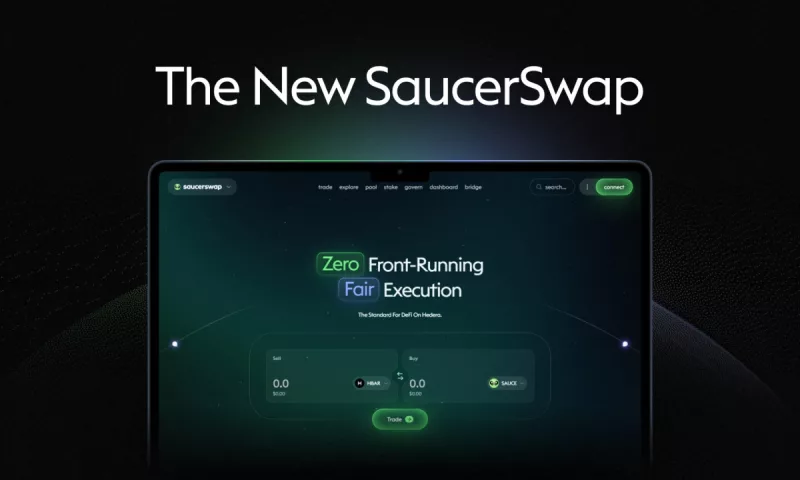
The SaucerSwap redesign, unveiled December 17, 2025, delivers a fully rebuilt platform and refreshed brand identity for Hedera's leading decentralized exchange. It explicitly preserves the audited smart contracts and non-custodial architecture users already rely on. SaucerSwap Labs framed the update as marking the protocol's evolution from startup to infrastructure, reflecting years of growth since its 2022 launch.
What Actually Changed in the Redesign
The platform is now organized into clear, action-driven sections: trading, token discovery, liquidity provisioning, staking, governance, and portfolio monitoring each have dedicated views. Users can move from a token swap to providing liquidity, staking SAUCE, or voting on a governance proposal in seconds. That's a meaningful improvement in workflow efficiency, compared to navigating a less structured interface for the same set of actions.
Standardized Data Display Across the Platform
The redesign standardizes how information is displayed throughout the app. Pair and pool charts, liquidity depth, fee APYs, LP position analytics, historical performance, and protocol health metrics all follow consistent visual patterns. That consistency reduces the cognitive overhead of interpreting different data displays scattered across different parts of an app, a common usability problem in DeFi interfaces that have grown organically over time without a unifying design system.
New Cross-Chain Bridge Functionality
A bridge modal now connects Hedera to external networks including Base and BNB Chain. It makes it easier to move capital in and out of the Hedera DeFi ecosystem directly from within the interface, rather than requiring users to navigate to a separate, standalone bridging application.
What Explicitly Did Not Change
The redesign doesn't alter the protocol's audited smart contracts, non-custodial architecture, or on-chain governance via SAUCE and xSAUCE. Existing LP positions, stakes, and rewards remain entirely intact. Everything users have already built carries over unchanged. That distinction matters for a DeFi protocol redesign. Users need assurance that a visual and structural overhaul doesn't quietly alter the underlying contract logic governing their deposited funds.
SaucerSwap's Scale Heading Into This Redesign
Since launching in 2022, the protocol has grown from an early-stage automated market maker into Hedera's dominant DeFi platform, routing the majority of on-chain liquidity on the network and processing tens of millions of swaps. The redesigned platform brings the user experience in line with that scale, introducing clearer information architecture and analytics built directly into every workflow, rather than bolted on as an afterthought.
What CEO Peter Campbell Said About the Redesign's Purpose
Peter Campbell, CEO and Co-founder of SaucerSwap Labs, said everything has been rebuilt to feel fast, trusted, and intuitive, whether someone is discovering Hedera DeFi for the first time or is a professional trader. He described the platform as "a serious workstation for capital." That signals an intent to serve more sophisticated, higher-volume users alongside newcomers, rather than optimizing purely for a beginner-friendly experience.
This redesign reflects the same infrastructure-maturity push seen in MINGO's ticketing platform built on Hedera. Both show continued application-layer investment across the Hedera ecosystem.
Glossary
- Automated market maker (AMM): A decentralized exchange mechanism that uses liquidity pools and algorithms to price and execute trades, rather than a traditional order book.
- xSAUCE: SaucerSwap's staked governance token, representing staked SAUCE used for voting on protocol proposals.
- Bridge: A mechanism allowing assets to move between different blockchain networks.
Disclaimer
For informational purposes only, this article does not constitute financial or investment advice. DeFi protocols carry smart contract and market risk. Confirm current platform features directly through official SaucerSwap documentation.